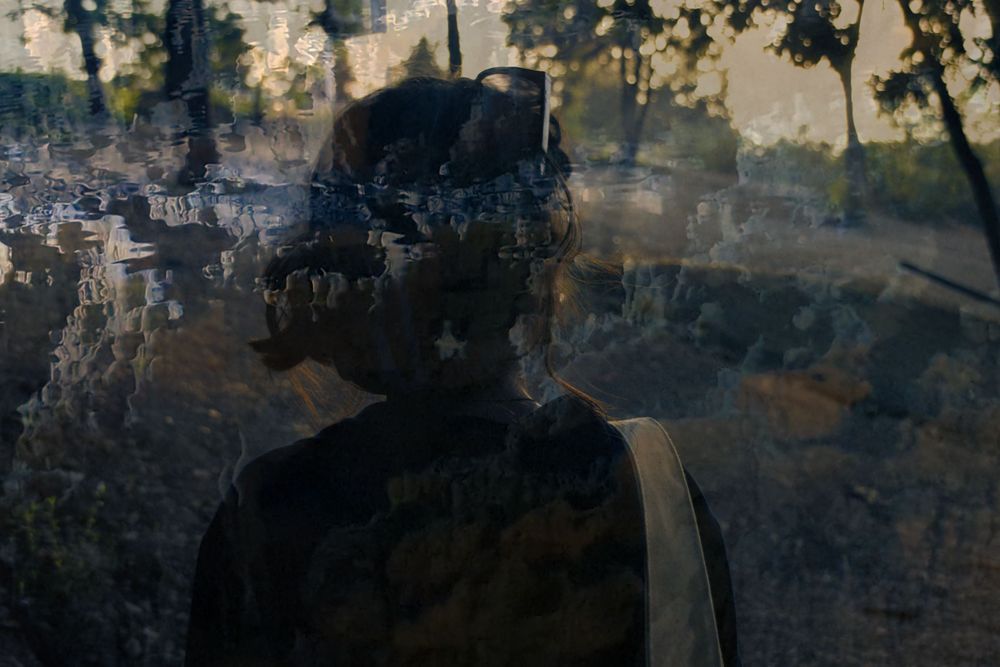
Gorg O Mish (Twilight)
Radin KhodadadiAn experimentation with perceived movement and composition, drawn from six years of photographic fragments—an imprint of shifting visions, where seeing becomes both a subject and a mirror. “Gorg O Mish,” a Persian expression for twilight, can be translated literally as “wolf and ewe.” This film is named after the liminal moment between day and night when shapes blur and certainty falters; when you can’t distinguish a sheep from a wolf. This film lives in space of confusion, ambiguity, and quiet transformation.
Fragments of
Elena Calvo PoloThe film, made without a camera, shows the support itself, shows the splices, works the declared montage, reveals the lateral perforations and does not limit itself to showing only the space of the frame, as well as intervening manually on the emulsion.
Alley
Defne KirmiziThe camera lingers, tracing a quiet alley where people are glimpsed, reflected, and lost. A game unfolds, where shifting perspectives turn passersby into performers. Elsewhere, landscapes are slipping away and rebuilt on a cyclical pattern. A brief syncopation in a daily routine, an interplay of bodies and place in motion.
Anomalies dans le paysage
Félix CaraballoAnomalies dans le paysage is a film in four tableaux in which four audiovisual landscapes unfold in all their strangeness: Spices, leaves, and local seaweed reveal and imbue their hues into this film which was shot and developed on the very banks of the Magtogoek (St. Lawrence) River from which it was composed.
An Archive of Disappearing Sounds
Michaela MichalakAn Archive of Disappearing Sounds is a meditation on environmental grief by evoking a contemplative cinematic space through listening as praxis. As light and sound pollution from settler cities encroach, what inaudible sounds are heard in the disappearing silences of the Land? This film reflects on Indigenous critiques of the increasing scales of ecocide resulting from settler colonialism through tracing genealogies of extinction.
El ruido del tiempo (The Noise of Time)
Patricio EscartínIn Xoco, Mexico City, the spirit of a villager awakens in search of its lost home. In their journey, the ghost discovers that while Xoco still celebrates its festivities, a new commercial complex, Mítikah, threatens the existence of both the traditions and the town.
过去的鬼魂在低语 (The Land Where Ghosts Could Speak)
Tianhui WuIn this personal piece, the artist uncovers memories through sleep talking, exploring the tension between her body’s recollections and her mind’s amnesia. Using family archives and her own body, the film delves into her trauma, revealing a broader conflict between individual identity and the unspoken violence within family and state.
blue & sentimental
Chloë GordonAn exploration of the loss of physical media and growing up in the age of technology, blue & sentimental is made up of digital video frames transferred onto watercolour paper via a cyanotype process, scanned, and re-animated at twelve frames per second. The archival footage and accompanying audio, shot by the filmmaker's father, documents the first days home from the hospital as a newborn up until kindergarten graduation.
Gacela Herida (Wounded Gazelle)
Diana EstherA mother writes to her five- and two-year-old daughters during their forced separation, letting her words drift across a sea of distance.
Weird Absurd Whatever
Zeynep DadakWorking from the enforced absence of filmmaker-producer Çiğdem Mater—sentenced to 18 years in prison in a trial tied to the 2013 Gezi Park protests for a documentary she never shot—Dadak and Kahraman braid dreams, screen captures, and AI images into a rehearsal for release, summoning Mater as a still-imagined free artist against the state’s attempt to erase her.
our bodies hold time
Our bodies hold time. Time indiscriminately settles into our soft and heavy shapes, defining and characterizing land, body, and artifact. Rust, dust, wrinkles, and mold surface and become textures of memory. Our presence and residency in time are marked by these textures. Through their tactility, we embody times passing.
our bodies hold time features nine student-made films that disassemble and collage cinematic time. Through a process and treatment of its passing materialized in film, Western conceptions of time are counteracted by the films’ own pacing.
In the program’s opening, Gorg O Mish (Twilight) by Radin Khodadadi invokes a sense of disorientation of time in a fragmented yet rhythmic pacing as seeing becomes both a subject and a mirror. Over the span of a six-year production, Khodadadi’s film was patiently moulded by time’s alterations.
Fragments of by Elena Calvo Polo follows an assortment of found footage reels collaged and projected in a non-linear fashion. As timelines merge, the past is reassembled. By the worn condition and mending of the reels, the feeling of time becomes tangible through the materiality and fragility of Polo’s craftsmanship.
In Alley by Defne Kırmızı, time sits in passivity with a camera capturing walking pedestrians. Wisps of movements come in and out of frame as the pedestrians become unknowing performers. As time marinates, Alley unfolds as unfolds a lapse in time.
Chemistry in filmmaking is tended to delicately by Félix Caraballo in Anomalies dans le paysage. The Magtogoek / St. Lawrence river is embedded into Caraballo’s film through an eco-processing development. Harvesting from the river banks, ANOMALIES DANS LE PAYSAGE emerges in nature's time.
An Archive of Disappearing Sounds by Michaela Michalak mediates on the Land and its silences. Time is characterized not only by visual imprints of identity but as well as the audible and inaudible sounds that shape it.
Patricio Escartín’s El ruido del tiempo (The Noise of Time) follows the awakened spirit of a villager searching for its lost home in Xoco while witnessing how the construction of Mítikah threatens the land and its tradition. When time is colonized and weaponized, culture is neglected. Land and its ancestral bodies decay.
过去的鬼魂在低语 (The Land Where Ghosts Could Speak) by Tianhui Wu uncovers memories recollected by the body and mind’s amnesia. The body remembers and the unhealed past can carry forward, settling unconsciously into our crevices.
In blue & sentimental by Chloë Gordon, cyanotypes from a family’s archive are animated. In twelve frames per second, memories re-emerge in shifting tones of blue pigments. Tangible, blue & sentimental crystalizes nostalgia onto watercolour paper.
In the program’s closing, Herida (Wounded Gazelle) by Diana Esther recites entries from a mother written to her separated daughters. As custodians of time, memories resurrect and are recontextualized by following generations.
Time acts in dualism to erode and erect. Its presence is here and gone. By a phantom of gravity, it organically moulds us. our bodies hold time forms by the pacing of nine films that become and dissolve into memories, frame-by-frame.
Please join us for a conversation after the screening with Chloë Gordon, Michaela Michalak and Ghislan Sutherland-Timm.
129 Spadina Avenue
CineCycle is not yet fully wheelchair accessible. The laneway entrance beside 129 Spadina has two steps and no automatic doors. The rear entrance has no steps, but the path is uneven. Inside, the space (including gender-neutral washrooms) is all on one level. We're working with the 401 building to improve accessibility. If you have any specific access needs or would like to arrange a walkthrough, please get in touch.
For a map to CineCycle, click here